Luxury Vinyl Plank in Denver: Why We Love It, and When It's the Right Choice for Your Home
At Floor Coverings International of Aurora-Denver, CO®, we help homeowners create the version of their home they have been dreaming of. When we are in your living room with samples laid out across your floor, in your actual light, we know it can get overwhelming fast. There are a lot of choices, a lot of sales pressure floating around this category (not from us), and a lot of small details that genuinely should impact your choices.
Some people make their best decisions right there in that conversation. Others do their best thinking on their own before they talk it through with anyone. This guide is built for that second person. It is the long version of the conversation we would have in your living room, written so you can read it at your own pace, return to the parts that matter to you, and walk into a consultation already knowing what to ask.
This is not a sales pitch. It is the honest version of what we tell customers about luxury vinyl plank with insights from our owner-operator, Justin George: what we love about it, what makes one product genuinely better than another, where it shines, and where we would steer you somewhere else.
Table of Contents (click to jump to each section):
- What Is Luxury Vinyl Plank (LVP) Flooring?
- What Makes One Vinyl Plank Floor Better Than Another?
- LVP Flooring Installation in Aurora & Denver: What Most Homeowners Don't Know
- When LVP Is Not the Right Answer
- Get Help Choosing the Right Floor for Your Aurora or Denver Area Home
What Is Luxury Vinyl Plank (LVP) Flooring?
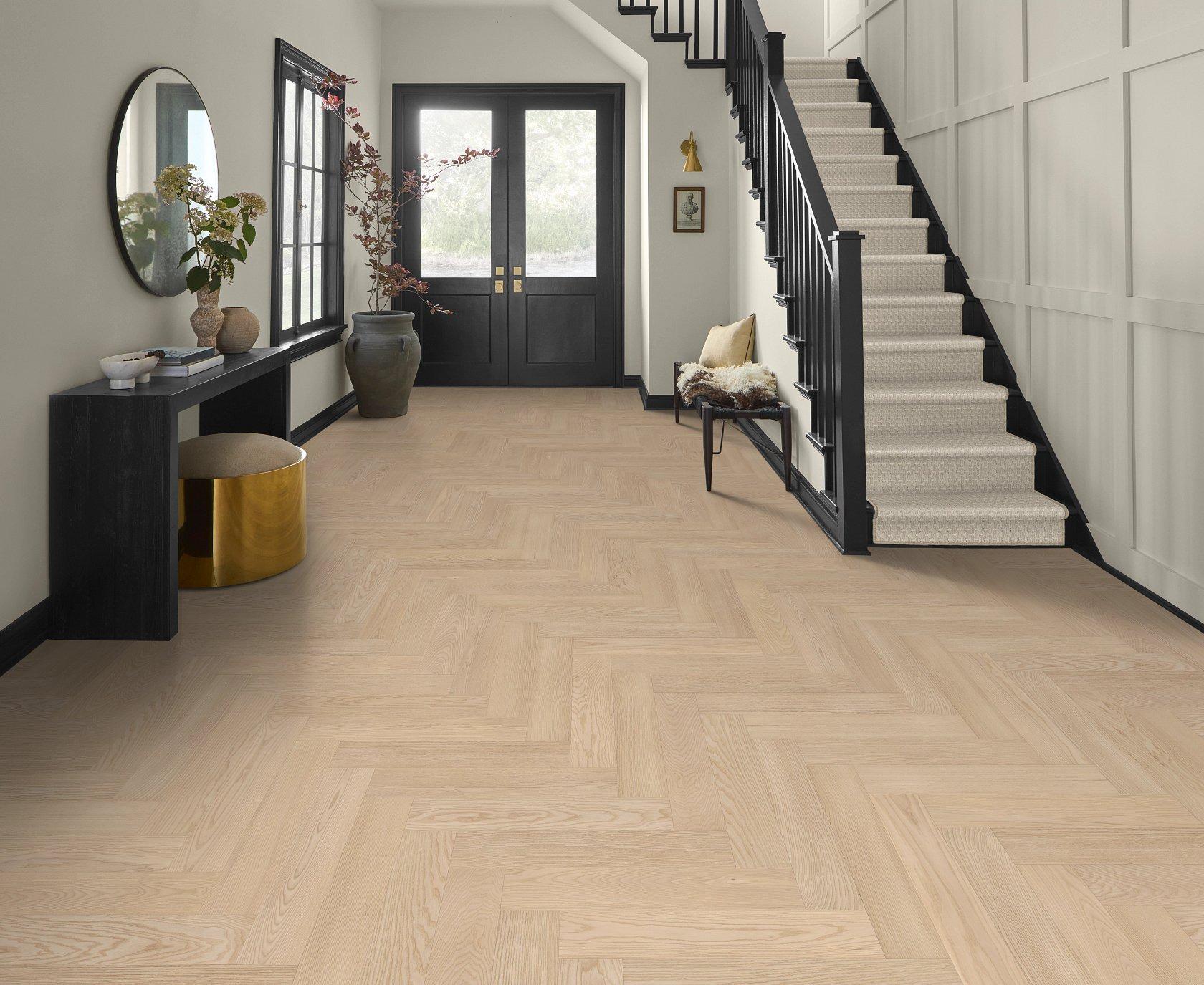
Luxury vinyl plank, or LVP, is a multi-layer, plastic-based flooring built to replicate the look of real hardwood while adding water resistance, durability, and easy maintenance. A modern plank combines a high-definition wood image, a textured surface, a protective wear layer, and a rigid core for stability.
The first time I saw a really good luxury vinyl plank installed, I knelt down to be sure. From standing height, it looked like beautiful hardwood. From a foot away it still looked like wide-plank white oak. I had to actually touch it to be certain. There are LVP options on the market now that I, in the flooring business, cannot tell apart from real wood at a glance. Sometimes even up close. The quality of the printing and the construction have come a long way, and it would be silly to think it is going to stop improving.
Vinyl plank as a category has been around since the 1970s. It took off in the 2000s with better click-lock systems, and the modern rigid-core era began in the early 2010s. The floor we install today is not the vinyl your parents had in the 1980s. A lot has changed.
Why Homeowners Choose LVP Flooring in Aurora and Denver
LVP solves real problems for real households. It handles water better than almost any other wood-look floor, stands up to pets and kids, installs faster than hardwood, and delivers the look people want at a price that lets them do the project now instead of in two years.
The wood looks have become believable, the textures track the printed grain, and the wear layers are engineered for households with kids, dogs, dropped plates, and Colorado winters that drag mud and grit through the back door for six months of the year.
Many homeowners choose luxury vinyl plank in Denver, CO and the surrounding areas for its:
- Best in class for water resistance
- Strong scratch and dent resistance with the right products
- Durability against everyday accidents, spills, and scuffs
- Wide visual range, from clean modern to character-grade rustic styles
- Reasonable installation timeline compared to most hardwood projects
I love LVP because it lets a customer get the look they want at a price that does not force them to wait another two years to do the project. I love it because it handles real life, doesn’t just look good in a staged model home that never gets used. And I love it because, in a category that used to be a compromise, the better products no longer feel like one.
That said, the variation inside the LVP category is huge. Two products that look similar on a sample board can perform very differently five years in. Next, we’ll cover how to tell them apart.
Luxury Vinyl Plank Flooring Pros and Cons
LVP comes with many advantages and trade-offs. It’s not always the best choice for every project or space. Considering where it excels and where it struggles as a flooring product are essential to making sure it’s the right fit for your Colorado home.
Pros
- Best-in-class water resistance for kitchens, baths, entryways, and basements
- A durable wear layer built for real, active households
- Wide, convincing wood looks across many colors and styles
- More comfortable and quieter underfoot than most flooring
- Faster installation and less disruption than most other flooring types
- Lower cost than most flooring, and low day-to-day maintenance
Cons
- It is a plastic-based product, not natural wood
- It can dent under heavy point loads such as appliance feet or dropped tools
- It fades under sustained UV and moves dimensionally with heat, which makes sun-exposed rooms a real design consideration
- It can feel thin or plasticky under your feet versus a natural product
- It cannot be sanded and refinished the way solid hardwood can
- Lower-end products can look repetitive across a large room
- Performance depends heavily on subfloor prep, expansion gaps, and installation quality
What Makes One Vinyl Plank Floor Better Than Another?
The look of the vinyl product is not what changes the most as you spend more, performance is. The biggest drivers of cost are the wear layer, dimensional stability, pattern variation, plank size, and warranty.
Two products can look nearly identical in a showroom and perform completely differently over time. Here is what actually separates them.
Wear Layer: The Most Important Performance Spec
Wear layer is the clear film on top of the printed design. It is the part that takes the scratches, the dragged chair legs, the dog nails. A mil is a thousandth of an inch, not a millimeter, and the two get confused constantly on showroom floors. A premium wear layer is also more than a thicker sheet of plastic. The better products use engineered top films with additives like ceramic beads, quartz, or aluminum oxide, which is why two planks with the same mil number can perform very differently.
The right wear layer depends on how you live. The best vinyl plank flooring for dogs, constant scruffs, scratches, and abrasiveness of grit tracked through the door is usually one with a thicker wear layer that holds up longer. It protects the printed image underneath and is usually the spec a product's residential warranty is written around. The busier the household, the more wear layer earns its cost. A quiet bedroom does not need what a kitchen with three kids and a Bernese mountain dog needs.
One honest note from experience: the thickest wear layer is not automatically the best-looking floor. On some products, a very heavy wear layer can leave the printed image underneath looking slightly cloudy or milky. It is subtle and many homeowners never notice it, but it is the kind of detail you only catch on a full-size sample in your own light, which is one more reason we bring the samples to your home in Aurora or Denver, CO, instead of asking you to judge from a small chip under store lighting.
Thickness and Feel Underfoot
Thicker does not automatically mean better and there is a point of diminishing returns. But when you stand on a two-millimeter LVP, you know it. Flooring carries a massive load, and houses are never perfectly drawn cubes. When a thin plank is laid over normal subfloor variances and you, a moving, impact-producing human, walk across it, you can feel the imperfections underfoot. In Colorado homes, where subfloors are rarely perfect and temperature fluctuations are constant, this matters more than most people expect.
Pattern Repeats: The Detail Most Homeowners Never Ask About
This might be the single most useful thing in this entire guide. The human eye is remarkably good at spotting what is not natural. Real wood almost never repeats the same swirl, knot, or grain run. Lower-priced LVP with minimal pattern variation shows you the same plank face again and again across a room, creating what installers call a stamped look. For some homeowners it never registers. For others it is the kind of thing they cannot unsee.
The number of distinct printed faces in a product is how long the floor goes before the grain visibly repeats. Lower-cost LVP often has six to eight unique faces. Mid-tier usually runs twelve to fifteen. Premium and design-driven lines push to thirty or higher. Engineered Floors, one of the brands we carry, is a clean example: their value lines use six unique visuals, while their PureGrain High-Def line uses thirty-five per style with embossing aligned to each grain. Same manufacturer, very different outcomes. Both have a place. The point is that you should know which one you are choosing before it goes down.
Plank Size and Design
Plank size changes how a floor reads more than the print itself. Wider planks of seven to nine inches make rooms feel larger and read modern, contemporary, or coastal. Narrower planks of three to five inches read traditional and classic. Longer planks with fewer end seams tend to look more upscale. Scale matters though: wide planks can overwhelm a small powder room and narrow planks can feel busy in a great room. This is exactly why we bring full-size samples into the actual room, where you can quickly tell whether the scale works or does not.
SPC vs. WPC Vinyl Flooring: Which Is Better?
Neither is automatically better. SPC has a dense stone-and-PVC core that is harder to dent and more stable through temperature swings. WPC has a foamed core that feels softer and quieter and is more forgiving over an imperfect subfloor. The right one depends on the room, not the price.
Most modern rigid-core LVP is built around one of these two constructions. SPC stands for stone-plastic composite, with a core of calcium carbonate (essentially limestone) mixed with PVC. WPC stands for wood-plastic composite, with a core of PVC, wood-like fibers, and a foaming agent that adds air. Here is how they compare:
|
Factor |
SPC (stone-plastic core) |
WPC (wood-plastic core) |
|---|---|---|
|
Feel underfoot |
Firmer, transmits a little more sound |
Softer, warmer, quieter |
|
Dent resistance |
Higher, better under heavy point loads |
Lower under heavy point loads |
|
Stability in temperature swings |
Higher, better suited to Colorado |
Slightly less, more temperature-sensitive |
|
Forgiveness over an uneven subfloor |
Less forgiving, wants a flat subfloor |
More forgiving of minor imperfections |
|
In a basement over slab |
Usually the safer pick, holds dimension through basement temperature swings |
Workable in a conditioned, flat, dry basement, and warmer and quieter underfoot |
|
Typical price |
Lower at comparable spec |
Often 10 to 20% more at comparable spec |
|
Often the better fit for |
High-traffic main floors, pets, active homes, basements |
Bedrooms, comfort-first rooms, floors over slightly imperfect subfloors |
We carry both and choose by project. A high-traffic main floor with kids in cleats might be an SPC conversation. A bedroom can easily be a WPC conversation. Those are starting points, not rules. If a salesperson tells you SPC is just the cheap option and WPC is the only quality choice, that is a simplification. Both have entry-level and premium versions, and both have real advantages of their own.
SPC vs. WPC in a Basement: What We Recommend and Why
We often hear homeowners asking what the best LVP for their basement in Aurora and Denver is, because so many homes here have a finished or half-finished basement.
For most Colorado basements we lean towards specific products, not general rules about SPC or WPC. The dense limestone-and-PVC core of SPC does not absorb water, swell, or warp, and it holds its dimension through the wider temperature swings a below-grade room typically sees. WPC is still a legitimate basement choice in a fully conditioned, flat, moisture-tested basement where comfort underfoot is the priority or where some variance remains even after leveling.
Two things make a basement different from the rest of the house, and both point the same direction.
The first is what the slab does. Concrete holds and releases moisture. Even a slab that reads bone dry on the surface pushes water vapor up from the ground through the pores in the concrete, a process called vapor drive. That vapor does not care what the plank looks like. It is a constant, low-level condition the floor lives with for its entire life. Both SPC and WPC are waterproof as products, so neither one rots. The difference shows up in what the vapor does to the assembly underneath: the adhesive in a glue-down install, the underlayment, and anything trapped between the slab and the floor. The good news is Colorado is a dry climate, so there are often periods when this has less of an impact than it does in other areas of the country.
The second is temperature. A basement is usually the least conditioned finished space in the house. It runs cooler in winter, is often on a weak return or has no dedicated zone at all, and can see temperature swings more day-to-day than the main floor does. Rigid-core LVP expands and contracts with temperature, so a room that swings more will demand more of the product's dimensional stability. That is the specific reason SPC tends to be the safer basement pick. The dense core moves less for the same change in temperature. But it is also easy to argue in the other direction, that all these reasons give you a need to have something with the benefits of WPC.
WPC still has a real case in below grade spaces. It is warmer and quieter underfoot, which matters more in a basement than almost anywhere else in the house because concrete is cold and basements echo. Many WPC products carry an attached cork or foam backing that masks minor slab irregularities, which is useful over a trowel-finished basement slab that is not perfectly flat. If your basement is fully finished, actively heated and cooled, and the slab tests dry and flat, a good WPC will do well and will feel better under your feet.
Here is the part we would rather you take away:The core matters less than the slab. A well-chosen WPC over a slab that has been moisture-tested, ground or leveled flat, and gapped correctly at every wall will outlast a premium SPC laid over a wet, wavy slab with the baseboard pinning it down. If a basement quote does not mention moisture testing, ask why before you compare the product names.
What LVP Is Actually Made Of (An Honest Note)
This does not come up enough in flooring conversations and it deserves to. Luxury vinyl plank is a plastic-based product. The core is PVC mixed with limestone or wood-like fibers, the protective wear layer is a plastic film, and the print is a high-resolution image adhered to the plank. It is well engineered and best-in-class for low-maintenance homes.
For some homeowners, that composition does not matter at all. For others, it does. If you have built your home around natural materials or you have a strong preference for real wood, the right answer for your home may not be LVP. For the record, I have LVP in my own home!
The Truth About "Scratch-Proof" and "Dent-Proof" Claims
No flooring is truly scratch-proof, dent-proof, or pet-proof, no matter what the box says. Not the highest tier of LVP, not engineered hardwood, not solid hardwood. Anything with enough force in the right spot can leave a mark.
Here is a fact that puts it in perspective: Some LVPs, especially thinner products, are installed by being scored and snapped with a utility knife on the jobsite. The blade goes right through it. That same product can be marketed as scratch-proof. Both can be true in marketing copy, but you deserve to know the actual physical limit of what you are buying.
The questions that matter are the real ones. How much traffic walks through your kitchen on an average day? Do you have dogs whose nails need trimming? Does your future LeBron-in-training bounce a basketball from the front door to the island? There is no judgment in those questions, only real answers, and the right LVP for your home depends on them.
LVP Flooring Installation in Aurora & Denver: What Most Homeowners Don't Know
The single biggest predictor of whether an LVP floor holds up is not the product, it is the subfloor. It must be permanently dry, clean, smooth, and structurally sound, and its flatness should be measured, not eyeballed. Most LVP manufacturers allow no more than three-sixteenths of an inch of variation across ten feet, a number that is written in the warranty.
There is a clear way to check, and it does not involve guessing. With the subfloor exposed, a long straightedge or level laid across the surface shows exactly where it rises and dips and by how much. If the variance exceeds the manufacturer's installation guideline, the subfloor is out of spec, and installing over it anyway is one of the fastest ways to void an otherwise good warranty. Some products are stricter still, closer to an eighth of an inch across six feet, and very few rooms pass by eye.
When a subfloor is out of tolerance, there are two ways to bring it back. High spots get ground down, which is effective but produces serious dust and may require containment. Low spots get filled with self-leveling underlayment, which needs drying time plus additional material and labor. Both options add cost but that is not a reason to skip them. It is the reason we measure first and show you the reading, so the decision gets made with you before installation day rather than sprung on you in the middle of it. Older Aurora and Denver area homes, especially ones with poured slab or trowel-finished basement concrete, are exactly where this work most often comes up.
Why Colorado Subfloors Vary So Much, and Why It Changes the Conversation
If you take one thing from this section, make it this: the subfloor under a Denver metro home is less predictable than the subfloor under almost any home in the country, and that unpredictability can affect how your flooring performs for years after it goes in.
The reason is the soil. Clay-heavy soils along the Front Range take on water, swell, and then shrink back when they dry. Those forces do not stop at the foundation. They show up as cracked basement slabs, cracks in walls, and, over the years, foundations that are no longer sitting where they were poured.
That history produces real variance from house to house, and even room to room inside the same house. A few of the things we find:
- Slabs that have already moved. A basement slab that has had years to settle may not go back. It leaves a long, gentle rise or dip that reads as flat to the eye and fails a straightedge immediately.
- Additions and remodels that met in the middle. A home with a converted garage, a bumped-out kitchen, or a basement finished by a previous owner frequently has three different subfloor heights and three different substrates within one continuous run of flooring.
- Plywood subfloors with their own history. Upstairs, older sheathing with crowned seams, squeaks, deflection between joists, or patched sections from a plumbing repair nobody mentioned at closing are all yellow flags that need investigating.
- Installations over existing flooring. It is common to find vinyl or laminate that a previous owner installed right over the original floor, and those layered installs carry risks of their own: asbestos testing requirements before older material can be disturbed, height problems at walls, trim, and doorways, and plumbing clearance challenges, among other surprises that only show up during demo.
- Gypcrete underlayment. This softer, gypsum-based material shows up in condos, townhomes, and some multifamily constructions, and it is delicate. It commonly creates crumbling or powdery areas that need sealing or leveling before a new floor can go over it, which makes it one of the subfloor types where prep work is usually part of the honest quote.
None of this is a reason to be nervous about your house. It is the reason we bring a straightedge and a moisture meter to the job instead of assuming. It is also why subfloor preparation for LVP is a real line of thinking on Colorado projects rather than a box to check, and why the right product for your home partly depends on what we find. A slab with mild waviness may point toward a product with an attached backing that is more forgiving. A slab that is dead flat opens the whole catalog. In either case, we would rather show you the reading than just hope it will be fine.
Why Flatness Matters at the Click Joint
Most LVP installs today use a click-lock joint where two planks snap together along their edges. It is a clever system, and it is also the part of the floor that fails first when the subfloor is not flat. Floors are under constant stress from the static weight of furniture and the moving weight of foot traffic. When the subfloor under a plank has a high spot, a low spot, or a soft spot, the click joint above it flexes a little with every step. A little flex repeated thousands of times turns into joint separation. That is the kind of failure that announces itself quietly, in year two or three, and never gets better on its own.
The Conversation Most Flooring Companies Stay Quiet About
Now the part most companies do not bring up before they sign you. We cannot fully assess what is under your existing floor until we pull it up. We wish we had x-ray vision. So, our policy is the opposite of a surprise charge. We typically do not pre-bill you for subfloor work we cannot see in advance. If we pull your old floor and find an issue, we stop, bring you back into the conversation, and walk you through your options. Those range from installing your new floor as-is at no added cost, with full disclosure of the risks, all the way up to full manufacturer-spec leveling. You choose. There are no surprise charges added without your sign-off.
This is one of the things I built our business around. Home improvement is famous for the moment where the contractor finds an issue on day two and quietly inflates the bill. At Floor Coverings International of Aurora-Denver, CO®, we do not work that way. The reason is that I spent most of my career in hospitality, where the entire business runs on treating guests like family. We believe flooring should not be different.
Moisture Testing Over a Concrete Slab
Concrete holds and releases moisture in ways that a dry top surface will never reveal. A slab can look and feel completely dry and still be pushing vapor upward every hour of every day. Before any LVP install over a slab, the subfloor should be verified as in range for the specific product and adhesive, not assumed.
We measure instead of assuming. A slab install in your Aurora home starts with moisture readings, and when the numbers call for it, we put down a vapor barrier or another underlayment matched to what your home needs.
This is also one of the places where experience quietly earns its keep. A crew that has handled hundreds of Colorado slab installs reads a borderline moisture number very differently than a general contractor meeting the problem for the first time, and that experience is part of what you are hiring when you choose Floor Coverings International of Aurora-Denver, CO®.
Vinyl Plank Flooring Expansion Gaps: The Small Detail That Decides Whether Your Floor Stays Tight
An expansion gap is the deliberate space left between a floating floor and every wall and fixed object around it. LVP is a plastic-based product, so it grows and shrinks with temperature. The gap is the room it needs to do that. Without it, the floor has nowhere to go but up.
We are giving this its own section because it is the most commonly skipped step in the entire installation, and when it is skipped, the failure does not show up on the day the job is finished; It shows up months later, in the first hot stretch or the first hard cold snap, and by then most homeowners have no idea it was preventable.
Why the Gap Is Required, Not Optional
Nearly all rigid-core LVP is installed as a floating floor. The planks click to each other, not to the subfloor, so the whole floor behaves as one large, connected sheet that sits loose in the room. That is a good design. It tolerates minor subfloor movement, it installs faster, and it can be repaired. It also means the entire floor changes size together.
The amount a floor can expand is bigger than people expect. Common industry guidance is that an eighteen-foot run can grow roughly three-eighths of an inch on a hot afternoon, and a forty-foot continuous run can move up to three-quarters of an inch through a full temperature change. That is not a rounding error. That is more than the thickness of most baseboard reveals and it has to go somewhere.
If there is space at the perimeter, it goes there, invisibly, and comes back when the room cools. If there is no space, the floor pushes against the wall, the pressure travels back into the field, and the weakest click joints lift. That is what peaking and tenting are. The other version happens in reverse: a floor installed while the planks were warm or humid contracts as it equilibrates, and you get thin dark lines opening at the end joints across the room.
How Much Gap, and Where
The honest answer is that the brand is the authority, because it varies by product and the manufacturer warranty is written against their number. As a working range, most click-lock LVP calls for something in the neighborhood of a quarter inch to three-eighths of an inch at the perimeter, and larger rooms and sun-exposed rooms sit at the top of that range rather than the bottom.
The perimeter walls are the easy part. Everyone remembers those. The gap gets missed at the places that do not look like walls, such as:
- Door casings and jambs, where the plank needs to slide underneath rather than butt into the trim.
- Kitchen and bath toe kicks that were cut tight to the plank instead of leaving clearance.
- Pipes, floor vents, columns, and hearths, which each need their own clearance and a cover plate or trim ring.
- Stair nosings and thresholds where a transition is fastened through the plank instead of into the subfloor.
- Baseboard or quarter-round nailed down into the floor rather than into the wall, which pins the floor in place at the exact spot it needs to move.
There is also a related rule that has nothing to do with the perimeter. Floating LVP should not run underneath kitchen islands, cabinet runs, or built-in vanities that are then set on top of it. Those fixtures weigh enough to anchor the floor at that point, and a floor anchored in the middle of the room will buckle somewhere between that fixture and the nearest wall. Cabinets go down first, then the floor goes to them.
Long continuous runs are the last piece. Most manufacturers set a maximum run length before a transition is required, commonly somewhere in the twenty-to-forty-foot range depending on the product. In an open-concept main floor that runs from the front door through the kitchen to a back slider, that limit is easy to exceed without noticing. A T-molding at a doorway is not a design compromise. It is the floor being given a second place to breathe.
Where the Gap Goes When the Job Is Done
This is the part that reassures most homeowners: you will never see it. The perimeter gap disappears under baseboard or quarter-round, which is fastened to the wall and set just off the floor surface so the floor can still slide underneath it. Around pipes and posts it disappears under a trim ring. At doorways it disappears under the transition. A correctly gapped floor and a floor with no gap at all look identical on install day. The difference only becomes visible in year two, and only in one of them.
Acclimation belongs in the same conversation. Most manufacturers ask for the material to sit in the room where it will be installed, at normal living temperature, for a minimum of forty-eight to seventy-two hours before installation. Planks installed at a temperature the room will never return to are already the wrong size on day one, and that shows up as joint gapping within the first few months.
Visual Challenges You May Be Left With
Sometimes a small area has no clean, off-the-shelf way to cover the gap. Edges of cabinetry that cannot be undercut, metal railings, metal door casings, and a few other spots can leave a sliver of expansion gap visible when the job is done.
In those places, a color-matched caulk, blended to either the flooring or the wall finish, is usually the most practical solution, and there are custom and DIY options beyond it, such as small casings or trim pieces cut to fit and painted or stained to match. The one rule that matters: whatever covers the gap should attach to the fixed object or stay flexible, never hard fastened through the plank, so the floor underneath can keep moving the way it was designed to.
Can You Install LVP Over Existing Floors?
Sometimes yes, sometimes no. It can work over well-adhered vinyl or stable, flat hardwood. It never works over carpet, which is too soft to support the click-lock, and never over another floating floor, which moves independently beneath it. The savings are real (demo, disposal, timeline), but so are the trade-offs: added floor height, hidden subfloor issues, and possible warranty limits.
The first tradeoff is height. Adding LVP on top raises the total floor height, which sounds small until a door no longer clears the floor or a refrigerator will not slide back into its bay.
The second is what stays hidden: if your subfloor has an issue we would have caught during demo, we will not catch it now and it can surface through the new floor later.
The third is warranty, and we make sure every customer understands this before any work begins. Most LVP manufacturer warranties specify which substrates the product can go over and installing on an unapproved surface typically voids that warranty.
If you ask us to install over a surface we believe is unstable, we will tell you in advance and document the conversation. We never surprise people with this after the fact. Installing over existing flooring can be a smart call in the right scenario and a quietly expensive one in the wrong scenario, and we will help you make that call honestly.
How Long Does LVP Flooring Last?
Most residential LVP lasts about 10 to 20 years and often longer with a quality product and proper subfloor prep. The three factors that move that range the most are the wear layer specification, the quality of the subfloor preparation underneath, and how you plan to use the space.
A floor almost never wears out evenly across a house. It gets replaced because one part of it looks bad or feels wrong, and the rest of the room has to follow. So, the useful question is not how long the plank survives in a lab, it is which part of your floor will look tired first and why.
In our experience, the floors that come out early are rarely the ones that wore through. They are the ones that developed a problem the product was never going to solve on its own: joints that opened over a subfloor that was not flat, a strip of buckling in front of a sunny slider, or a basement install that skipped moisture testing. A mid-range product installed carefully will almost always outlive a premium product installed fast.
LVP in Colorado: What Our Dry Climate and Altitude Mean for Your Floor
Colorado is not a neutral environment for flooring. Dry air, large day-to-night temperature swings, intense high-altitude sun, expansive soils that move our subfloors, and basements with real moisture considerations all make dimensional stability and careful product selection matter more here than in most of the country. Not all LVP performs the same in this climate.
Dry Air and Temperature Swings
Low indoor humidity and daily temperature swings make dimensional stability a real factor, which is one reason SPC and thicker rigid-core products come up so often in our Colorado consultations. This is also where LVP has an advantage over solid hardwood, which is far more sensitive to our dry air.
Direct Sunlight and Heat: A Performance Issue, Not Just a Fading Issue
Sunlight does two separate things to an LVP floor. It fades the pigment slowly, which is cosmetic. It also heats the plank, which makes it expand and that is a performance issue. A vinyl plank floor can bubble up in sunlight when paired with a tight expansion gap, and that failure is structural rather than visual.
Most articles on this topic stop at fading. Fading is real, and it matters. UV light causes photodegradation, breaking down the chemical bonds in the material so it gradually loses color and eventually becomes brittle. Darker colors show it first. Denver sits at 5,280 feet above sea level and UV intensity climbs with elevation, running between twenty to twenty-five percent stronger here than at sea level. Our roughly three hundred sunny days a year compound that. So yes, a dark floor in front of a big south-facing window will lighten faster in Aurora, CO than the same floor in Ohio.
But the more expensive problem is heat, and it is the one almost nobody warns homeowners about.
A floor in the direct path of a sliding glass door or under a skylight is not sitting at room temperature. Glass concentrates solar radiation onto that strip of floor, and surface temperatures there can climb far past what the room feels like, into a range well above what most LVP is specified to tolerate. Industry guidance commonly cites surface temperatures reaching one hundred forty degrees or higher in that band of direct sun, against product specs typically written around a hundred to a hundred and ten degrees. The plank does what any plastic does when it gets hot. It grows.
Then Colorado adds its own twist. Our day-to-night temperature swing is unusually large, and our dry air means rooms cool fast once the sun drops. So, the floor in that sunbeam is not expanding seasonally, which the floor could easily absorb. It is expanding and contracting every single day, all summer. That is a fatigue cycle putting strain on the click joints hundreds of times a year in a narrow band of the room.
What that looks like when it goes wrong is specific and recognizable:
- A ridge or a soft hump on the floor a few feet in from the sliding door or window, that’s worse in the afternoon and better by morning
- A hollow or crunchy sound underfoot in that same strip, sometimes described as an oil-can pop
- End joints that have separated across the room in midwinter after the floor spent a summer being pushed outward
- On glue-down installs, adhesive that has sheared and released, so the plank lifts free of the subfloor
It is worth knowing that manufacturer warranties commonly exclude damage from sun and from exceeding the product's temperature specification, so this is one of the places where a floor can fail and not be covered. That is not a reason to avoid LVP, but it is a reason to plan around the room.
The good news is that all of this is manageable when it is handled up front. In a sun-exposed room we look at UV-filtering window film, shades, or cellular blinds for the brightest hours, products the manufacturer rates for high UV and heat, and expansion gaps set to the top of the manufacturer range rather than the minimum. Area rugs help protect a spot, though they also create their own fade line over time, so we would rather solve it at the glass than on the floor. For most rooms in most homes this is a non-issue. For sunrooms, walkout basements with a full glass wall, and big south or west exposures, it is a real conversation to have at the consultation, before the product is selected rather than after.
Basements and Concrete Slabs
LVP is one of the most common basement flooring choices in Aurora and Denver because of its moisture resistance, and because of what our soils do to other flooring types below grade. The steps that cannot be skipped are moisture testing over the slab and honest flatness work, so vapor or an uneven pour do not undo an otherwise good install. For which core to choose down there, see the SPC versus WPC in a basement section above.
How to Care for Your LVP Floor
Daily care is simpler than most homeowners expect. A dry sweep or vacuum with the beater bar off, plus a damp microfiber mop and a manufacturer-approved cleaner handles almost everything. The two things to skip are steam mops, which drive moisture into the joints, and over-saturated mopping that leaves standing water.
Residential LVP, properly installed and maintained, has a useful life of ten to twenty years and often longer. We email a care sheet at the end of every install so the right routine is never a guess! You can also check out our blog about how to clean vinyl floors for more info.
When LVP Is Not the Right Answer
LVP is a strong, honest answer that can often be used when you want matching floors throughout the whole home. There are a few places where it is not the first call, and we would rather tell you now than after.
- You want a real wood floor. If the look, feel, and aging character of genuine wood matter to you beyond visual mimicry, you want hardwood. There is a quality that comes with age to real wood that LVP does not replicate, even at the highest tiers. We install both LVP and hardwood flooring.
- You have radiant heat. LVP is possible only with products the manufacturer specifically rates for radiant, and even then, its insulating properties make the system work harder. Engineered hardwood and tile are usually the cleaner pairings for radiant heat.
- You have major height-transition challenges. If your existing floor is significantly taller, the new LVP can sit lower and create awkward step-downs, door clearance, and appliance-fit issues. Sometimes replacing with the same material as the existing floor is the simpler swap.
- The room takes hard direct sun for hours. Sunrooms and glass-walled additions are where we slow down and look at tile, outdoor-rated products, or the small subset of LVP engineered for high UV and heat.
Some of the Brands We Carry
We carry more brands than the ones below, and the list keeps growing as the category does. Here is a quick read on what each is known for, so you have a starting point:
- CALI Floors is known for stunning, modern visuals. If you want a floor that reads coastal, sun-bleached, or lightly contemporary without feeling overdone, start here.
- Engineered Floors is known for pattern variation, with the widest spread of value-tier and design-tier options inside a single manufacturer. Easy to compare and recommend.
- COREtec is known as the brand that started the rigid-core category, with cork-backed underlayment for acoustic comfort.
- Shaw is known for breadth, from value-tier residential to commercial-grade floors, and clean, modern looks to warm, traditional. An easy first pick while you narrow down style.
- Mohawk SolidTech is known for density and dent resistance, built for active households with strong character.
Visualize How Our Vinyl Products Look In Your Space
Get Help Choosing the Right Floor for Your Aurora or Denver Area Home
If you are weighing whether LVP is right for your home and want a real conversation about what fits your rooms, your subfloor, your household, and your budget, turn to Floor Coverings International of Aurora-Denver, CO® for a consultation that is no charge and no pressure. We bring the showroom to your front door and lay out full-size samples in your rooms, against your existing finishes, and in your actual light. Most homeowners narrow a wide selection down to their top two or three choices in a single visit.
You can reach us at (303) 995-5544 or by booking your free in-home consultation today. We are not just installing floors, we are trying to raise the standard of the whole experience around them in Aurora, Denver, and the surrounding Colorado communities.