Spending an hour on a concrete slab is brutal on your knees, hips, and lower back. This is precisely why rubber has become the standard gym flooring for many North Jersey gym owners and homeowners installing home gyms. The material naturally cushions, absorbs shock to reduce fatigue and protect your joints, while offering reliable traction even during workouts.
To choose the best rubber gym flooring for your home gym, we’ll look at different types of rubber flooring, common safety questions homeowners ask, and what rubber floors cost in North Jersey.
Ready to look through samples and get your home fitness space started? Our team at Floor Coverings International of North Jersey, NJ® make it simple to find the perfect rubber gym flooring with our Mobile Flooring Showroom®.
Book your free in-home consultation today.
How to Select Rubber Flooring for Gym Spaces
Thanks to the floors’ shock absorption, slip-resistance, and nearly indestructible nature, there's no dispute that rubber is the best flooring option for fitness spaces. If you’ve already started researching the best way to start your home gym, you already know that you have a handful of options when it comes to rubber gym flooring.
Let's talk about the different types and where they work best.
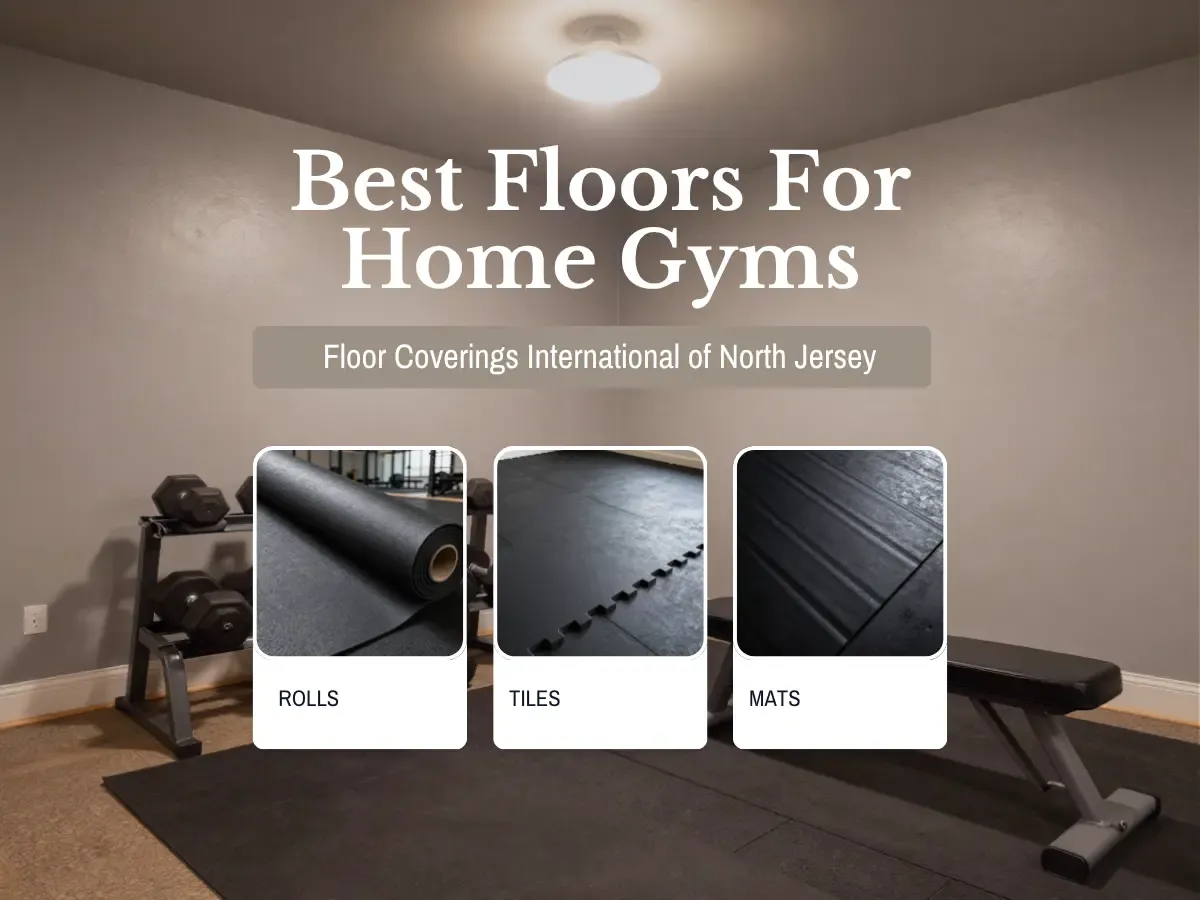
Rubber Rolls
Often considered the most professional option for a rubber gym floor in New Jersey, rubber rolls arrive as long continuous sheets that glue directly to the subfloor. Since the flooring has minimal seams and is anchored to the ground, it’s easier to wipe clean, has less pockets for moisture or bacteria to build up in, and gives sturdy footing for intense workouts. The flooring is best for large open spaces, like a finished basement gym.
- Pros: A professional look that seamlessly keeps out moisture and bacteria.
- Cons: Rubber rolls are heavy to ship and install. It's best to work with professionals for installation.
Rubber Tiles
For a smaller, more flexible gym space, you might prefer rubber tiles. These are squares that snap together for an easier install and are simple to repair by changing out damaged tiles. This style works best in spare room gyms, garage conversions, and multi-use spaces.
- Pros: Since the flooring is DIY friendly, repairs are straightforward, and you don’t even have to mess with adhesives with interlocking styles.
- Cons: The flooring has more seams, and edges can curl if not installed on a perfectly flat subfloor.
Rubber Mats
These are thick, heavy-duty rectangles you find for supply stores. Since they were originally designed for horse stalls, the mats are incredibly durable and have great shock absorption for gym flooring. It's ideal for heavy deadlifting platforms and garage gyms with a dedicated lifting or box jump area.
- Pros: The material is extremely durable and is usually the lowest cost per square foot compared to other gym flooring options.
- Cons: Weight. Normally over 100 lbs per mat. It also doesn’t look as sleek as some other flooring options, and the material has a strong rubber odor that eventually fades.
How Safe Is Rubber?
When you’re setting up a workout space in your home, you may have a lot of questions about the material and how safe it is to interact with every day. Is there significant off-gassing? Do the floors absorb enough impact to protect your knees from intense training? Here are some of the most common questions homeowners ask about rubber flooring in Bergen County:
Are rubber gym floors toxic?
High-quality rubber is perfectly safe for your air quality. However, not all rubber is made equally. Rubber type and how well-ventilated your workout space is are important factors to consider. A little later, we’ll go into more depth on rubber types.
Do you need to glue rubber gym flooring?
This depends on your use-case. When you’re planning on high-impact training, gluing the floors in is important to prevent shifting and seam curling, which can both be dangerous when you’re in the middle of an intense workout. However, for many typical to light exercise routines, securely locked rubber tiles offer enough traction without adhesives.
What's a safe thickness for rubber floors?
Again, this will depend on a few different factors. For general or light cardio workouts, we recommend 3/8th inch (or 8 to 10 mm) to cushion your joints from jumps and other floor exercises. However, when you’re dealing with heavy weights, 3/4th inch rubber (15 to 20mm) is safer for absorbing shock, protecting your joints, and saving the subfloor from damage.
Types of Rubber for Your North Jersey Gym Flooring
As previously mentioned, rubber comes in different grades. Some off-gas less than others and can help keep your home or business space safer from fumes.
Let's break down the difference:
- Virgin rubber is made from new EPDM (ethylene propylene diene monomer) or natural rubber materials that contain very low VOCs (volatile organic compounds). Since the material meets strict indoor air quality standards, like GREENGAURD Gold, it’s one we often recommend for daycares, yoga studios, and your home.
- Recycled rubber is made from ground-up tires, is often more affordable, and still safe for most gyms. However, it often has a stronger smell initially because of residual oils from the tires. While the smell is typically only a nuisance, we recommend avoiding cheap, unregulated recycled rubber that can contain trace metals or chemicals.
Our recommendation: If you’re installing in an enclosed basement with poor ventilation, which is common in older homes in Glen Rock or Hawthorne, it’s worth spending the extra money on virgin rubber or low-VOC recycled. But if the floors are for a detached garage or well-ventilated space, quality recycled rubber is perfectly fine.
How Much Do Rubber Floors Cost?
Let’s talk numbers. How much does rubber gym flooring cost in North Jersey? Like any flooring project, there’s a few elements to consider. This includes the size of the space, the type of rubber you’re installing, and any subfloor preparation that’s needed.
Here are some common prices you can expect:
- Interlocking tiles typically cost $5 to $11 per square foot with materials and installation.
- Quality rubber rolls are often between $8 and $18 per square foot including installation.
- Mid-range rubber stall mats run between $5 and $8 per square foot.
Why work with a Local Team?
You can easily search and order rubber floors online. But what happens when something goes wrong? By working with local professionals, like our team, not only do you get help with installation and insight on what will work best for your home gym, but you’ll also know who you can contact for rubber gym floor repairs in New Jersey.
Here's what a local North Jersey flooring company brings to the table:
- We know the subfloors here. We've seen the cracked slabs in Hackensack, the damp basements in Rutherford, and the unlevel additions in Ramsey. We test moisture, level the subfloor, and include underlayment that protects your flooring.
- We carry the right products. We stock rubber that performs well in our climate here in North Jersey. You won’t have to sort through questionable imports with unknown VOC levels.
- We handle the logistics. Our crew delivers, moves the material inside, installs it correctly, and hauls away debris.
- We stand behind our work. We follow-up after your rubber floor installation in New Jersey to make sure the floors are secure and functioning correctly. If there are any issues, we’re ready to help.
Ready to Enhance Your Home Gym with Sturdy, Shock-Absorbent Rubber Floors?
As your local rubber flooring contractor in Bergen County, New Jersey, we’ve installed rubber floors in basements, converted garages, and spare rooms all across the area.
If you’re ready to set up your home fitness space, call us at (201) 581-9207 or schedule a free in-home consultation. We'll bring samples, moisture testers, and professional advice to help you get started.